Property Value Estimator UK: How Much Is My House Worth?
The complete guide to getting a free, data led online house valuation, without the guesswork.
Updated April 2026 · 12 min read
If you have ever typed "how much is my house worth?" into a search engine, you already know the problem: you get a flood of instant valuations that feel plucked from thin air, with no explanation of where the number came from. This guide explains how Property Insights UK's free property value estimator works, what makes it more trustworthy than a generic house price calculator, and how to get the most accurate result for your specific home.
What Is a Property Value Estimator?
A property value estimator is an online tool that uses transaction data, comparable sales, and property characteristics to produce an indicative price range for a home. In the UK, the most credible estimators draw directly on Land Registry sold prices: the registered figures for every residential sale completed in England and Wales, rather than relying on asking prices or broad regional averages.
The key word is indicative. Even the best home value estimator cannot perfectly price a unique property. What it can do is anchor your thinking to real market evidence rather than anecdote, and give you a defensible starting point for negotiation, financial planning, or simply satisfying curiosity.
Our tool inside Area IQ does exactly this. It is built for UK homeowners, buyers, landlords, and anyone who needs a fast, transparent property valuation estimate grounded in what comparable homes on comparable streets actually sold for.
How Much Is My House Worth? The Honest Answer
Your home is worth what a motivated buyer will pay for it on the open market, on a given day. That figure is shaped by:
- Location and micro market. Two streets in the same postcode can have meaningfully different average sale prices depending on school catchment, proximity to transport, and the character of the street itself.
- Property type and tenure. Detached, semi detached, terraced, and flat transactions behave differently. Leasehold and freehold command different premiums depending on the remaining lease length.
- Floor area. Internal square footage is one of the strongest predictors of price per unit across almost every market segment.
- Condition and presentation. An algorithm cannot visit your home. Condition is where data led estimates and estate agent appraisals diverge most significantly.
- Market timing. The UK property market is cyclical. A property valuation estimate produced during a high demand period will look different from one produced during a correction.
Our house value estimator accounts for the first three factors directly through filters and inputs. For condition and timing, it gives you the context: comparable transactions, market trends, and local demand signals, so you can apply your own judgment.
Why Most Free Valuations Fall Short
Many "free online house valuation" tools share the same flaws:
- They show a single headline figure with no range, creating false precision.
- They use national or regional averages rather than postcode level comparables.
- They do not allow you to filter by property type, tenure, or date window, so a two bedroom flat and a five bedroom detached house in the same postcode get treated as equivalent data points.
- They give you no visibility into what is driving the number.
A credible online house valuation in the UK should show dispersion: the spread of outcomes in your comparables, because that spread tells you something real about market uncertainty and negotiating room.
How Property Insights UK's Estimator Works
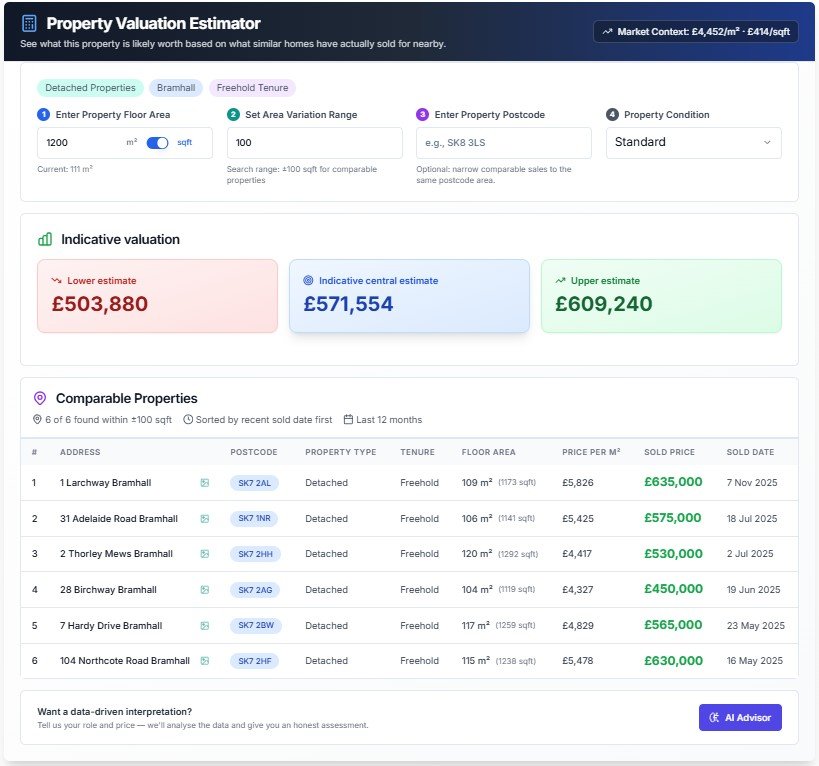
Our property valuation estimator is built into the Area IQ report and is built on comparables methodology:
- Step 1: Enter your postcode. Area IQ is designed around postcode first research. UK buyers and sellers anchor decisions to "what sold on streets like mine," not national headlines.
- Step 2: Run the Area IQ report. The report loads market statistics, recent sold prices, price per square foot benchmarks, and trend data for your local area.
- Step 3: Locate the Property Valuation Estimator module. Scroll to the dedicated section within the results dashboard.
- Step 4: Refine your comparables. Use the available filters for property type, locality, tenure, and date window to narrow the comparable set to transactions that genuinely resemble your home. Better matches produce a more meaningful property valuation estimate.
- Step 5: Enter your floor area. Adjust the internal area in square feet or square metres. Floor area is one of the most significant variables in any credible house value estimator.
- Step 6: Read the range, not just the headline. The output shows an estimated range, not a single number. That range reflects the actual dispersion in your comparables.
Property Value Estimator by Address: How It Works in Practice
If you are looking for a property value estimator by address or a house price estimate by address, the most reliable automated approach in the UK is postcode first, then micro market confirmation, then attribute alignment, then comparable interpretation.
We are deliberately postcode first because individual address level data in the UK is subject to significant noise. A single sale at an unusual price, such as a distressed sale, a sale between connected parties, or a property with undisclosed works, can skew an address level estimate dramatically. By starting at postcode level and filtering down, you get a more stable, defensible result.
This approach mirrors what experienced RICS registered valuers and estate agents do in practice: they identify the relevant comparable set first, then adjust for the specific characteristics of the subject property.
How Accurate Are Online House Valuations?
This is one of the most common questions we see, and it deserves a direct answer.
Accuracy improves as your comparable set improves. If you are in a dense urban area with dozens of similar transactions in the past six months, a data led estimate can be meaningfully precise. If you are in a rural area with infrequent sales, or in a street of highly varied property types, the range will be wider and appropriately so.
Accuracy deteriorates when filters are ignored. Running an estimate without filtering by property type or tenure is the single biggest source of misleading outputs. A leasehold flat should not be compared against freehold houses in the same postcode.
Online valuations are indicative, not authoritative. For a mortgage application, a probate valuation, a capital gains tax calculation, or a legal dispute, you need a RICS regulated valuation, not an automated estimate. Our tool makes this explicit.
The estimate is a starting point, not a final answer. Use it alongside estate agent appraisals and local market knowledge. If three independent data points (our estimate, an agent's appraisal, and the most recent comparable sale) are broadly consistent, you have a sound basis for your decision.
Market Value vs Asking Price: Understanding the Gap
One of the most practically useful applications of a house value estimator is sanity checking asking prices, both when you are buying and when you are selling.
For buyers: Compare the listed asking price to the estimated range from our tool. A property priced significantly above the comparable range may have justifications, such as exceptional condition, a recent extension, or rare plot size, or it may simply be optimistically priced. Either way, you go into negotiation with evidence.
For sellers: Use the estimate alongside your estate agent's appraisal to stress test the recommended listing price. Overpricing a property costs time and can stigmatise a listing; underpricing leaves money on the table. A data led property valuation for selling helps calibrate both risks.
For remortgage planning: Lenders conduct their own valuations, but understanding the likely market value of your home before speaking to a broker helps you identify realistic loan to value ratios and the products you are likely to qualify for.
Frequently Asked Questions
How much does it cost to use the Property Insights value estimator?
The Area IQ report, including the property valuation estimator module, is free to use. There is no registration required to run a postcode report.
Can I use this for probate or capital gains tax purposes?
No. A data led online estimate is not a regulated valuation and is not appropriate for probate, CGT, or any legal or tax purpose. For those scenarios, you need a RICS regulated valuer. Our tool can help you identify a realistic starting point before you commission one.
What if my property type is unusual, such as a converted barn, a listed building, or a new build?
Unusual or non standard properties are where automated estimates are least reliable. If your property has characteristics that are genuinely rare in your postcode, such as listed status, significant land, or non standard construction, treat the estimate as directional only and place greater weight on professional appraisal.
How do I find the value of my house on a specific street?
Enter the postcode for that street into Area IQ, run the report, and use the locality filter within the comparables section to focus on the immediate street or block. The "house values in my street" view gives you the tightest possible comparable set.
Getting the Most from Your Property Valuation Estimate
A few principles that consistently improve output quality:
- Match your filters to your property. The most common mistake is running a valuation on all property types in a postcode when you own a semi detached house. Filter to your type, your tenure, and a date window that reflects current market conditions, typically the last twelve months, or the last six in a fast moving market.
- Treat the midpoint as a hypothesis, not a fact. The estimated range midpoint is the most likely outcome based on your comparables, but the range itself tells you the degree of uncertainty. A wide range signals a heterogeneous market; a narrow range signals strong comparable evidence.
- Cross reference with an agent's view. An experienced local agent sees condition, presentation, and buyer sentiment that no algorithm can capture. Use the data to interrogate their appraisal. If their figure sits comfortably within your estimated range, that is strong convergent evidence.
- Run the report again before making a decision. Markets move. If you ran an estimate six months ago and are now ready to list, remortgage, or make an offer, refresh the report. Comparables and trend data will have updated.
Start Your Free Property Valuation
If you have been searching for a reliable, transparent property value estimator that shows you the evidence rather than hiding it, Area IQ is designed for exactly that purpose.
Enter your postcode, run the free report, and find out what comparable homes on comparable streets actually sold for. Then apply your own knowledge of your property to reach a confident, well grounded answer to the question every UK homeowner eventually asks: how much is my house worth?
Try Area IQ freeProperty Insights UK provides data led research tools for homeowners, buyers, and property professionals. Our property value estimator is indicative and does not constitute a formal valuation, mortgage valuation, or RICS survey. For regulated valuations, please consult a RICS registered professional.